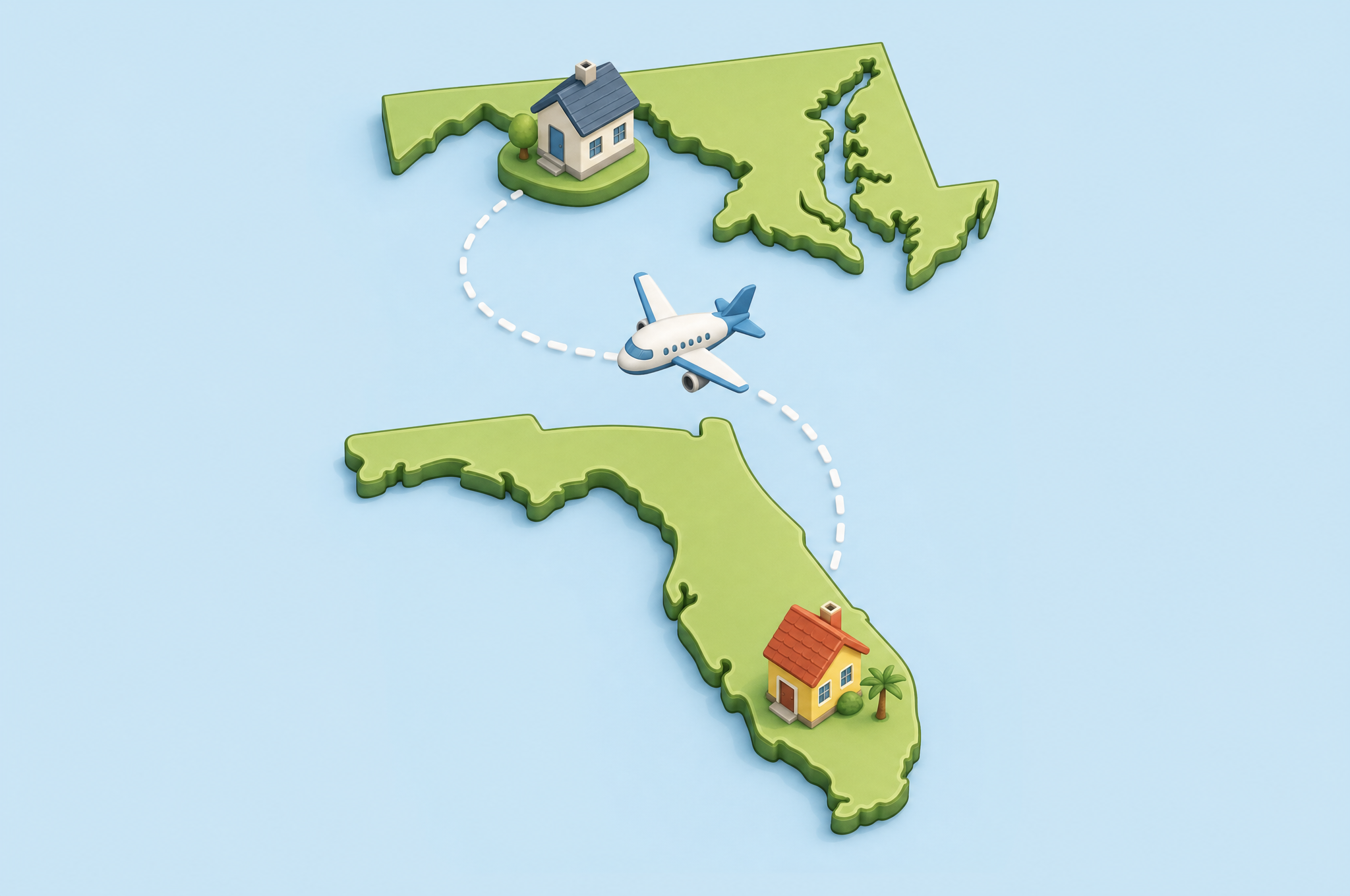
Maryland residents who own a second home in Florida often assume that one estate plan, possibly drafted years ago, covers both regions. It rarely does. Florida and Maryland are two of the most legally distinct states in the country when it comes to probate, real property titling, health care surrogacy, and the protections afforded to a surviving spouse. The differences are not academic. They surface at exactly the moment a family can least afford confusion.
The seasonal drive north each spring, paired with the start of Atlantic hurricane season on June 1, creates a natural window to confirm that the Florida side of an estate plan still functions. A coordinated review now is far less expensive, in dollars and in stress, than discovering a gap later. The following sections outline where snowbirds most often run into trouble and how a properly structured plan bridges the two jurisdictions.
1. The Two-State Problem Most Snowbirds Do Not Recognize
A Maryland resident who owns Florida real property in their individual name has, in effect, created two probate estates. When that person passes away, the Maryland estate handles personal property and Maryland-titled assets, while a separate ancillary probate must be opened in Florida to transfer the home. Ancillary probate requires Florida counsel, Florida filings, and Florida court timelines, all running in parallel with the Maryland process.
This is the single most common and most expensive oversight in two-state estate planning. Families frequently discover the problem only after a death, when the surviving spouse or children are already navigating grief and logistics. The cost is measurable in attorney fees, court costs, and months of delay before the Florida home can be sold, transferred, or refinanced.
2. Where Florida and Maryland Disagree, in Plain English
The two states diverge on several issues that directly affect a family. Florida recognizes a homestead protection that shields a primary residence from most creditors and restricts how it can be devised. Maryland has no equivalent. Florida has no state income tax and no state estate tax. Maryland imposes both, and Maryland is one of the few states that still levies an inheritance tax on certain non-lineal heirs. The question of which state is a person's true domicile carries real financial weight.
Health care documents create another mismatch. The Maryland Advance Directive and the Florida Designation of Health Care Surrogate are not interchangeable, and a hospital in Naples or Sarasota may refuse to honor a Maryland form during an emergency. Spousal protections also differ. Florida's elective share and Maryland's elective share calculate differently, which can produce unexpected outcomes for blended families.
3. Why a Living Trust Is Often the Right Bridge
A properly funded living trust is frequently the cleanest solution for snowbirds. When the Florida home is titled in the name of the trust rather than the individual, ancillary probate is avoided entirely. The trust holds the property regardless of which state the grantor was domiciled in at death, and the successor trustee can administer or sell the home without opening a Florida court file.
Funding is the step that often gets missed. Creating a trust document is not the same as transferring property into it. A deed must be prepared, signed, and recorded in the Florida county where the home sits. Without that recording, the trust provides no benefit for the Florida asset, no matter how well the document was drafted.
4. Hurricane Season as a Forcing Function
Atlantic hurricane season runs from June 1 through November 30, the months most snowbirds are back in Maryland. A direct hit on a Florida property raises immediate questions about insurance claims, repair authorizations, and access to the home, all of which require someone with legal authority to act. A durable power of attorney that names a Florida-based agent, or at least an agent who can travel quickly, becomes practical rather than theoretical.
The same season is a useful annual prompt to confirm that property insurance, flood coverage, and named-storm deductibles are current, and that the people named in the estate plan still match the family's intentions. Reviewing documents in May or early June, before the first named storm forms, is a habit that prevents avoidable problems.
5. One Family, One Plan, Two States
The goal is not two parallel estate plans. The goal is one coordinated plan that anticipates both jurisdictions. That means a living trust funded with the Florida property, health care documents valid in both states, a durable power of attorney that travels, and a clear answer to the domicile question for tax purposes.
A coordinated review with counsel licensed in the relevant jurisdiction, ideally a firm with a presence in both states, prevents the duplicate-plan problem and keeps the family from reinventing the same legal wheel every few years. The review itself is usually brief. What it protects is not.
Planning Across State Lines, Before the Next Trip South
Owning property in two states is a privilege, but it carries legal complexity that a single-state plan was never designed to handle. Maryland snowbirds who address ancillary probate, surrogacy forms, trust funding, and domicile questions before they become urgent give their families a clear path forward. The strongest plans are built when there is time to build them well.